
Comprehensive services from initial inspection and diagnosis, equipment selection, to construction and installation, assisting the management committee in solving ventilation issues in the property.
Improved ventilation in the communal building's common pipes
Poor exhaust ventilation between common pipes is the main reason why many residents in community buildings report foul odors and excessive moisture in the pipes. Da Ben Ying Co. Ltd. provides comprehensive services from initial inspection and diagnosis, equipment selection, to construction and installation, assisting the management committee with improving ventilation issues in the property.
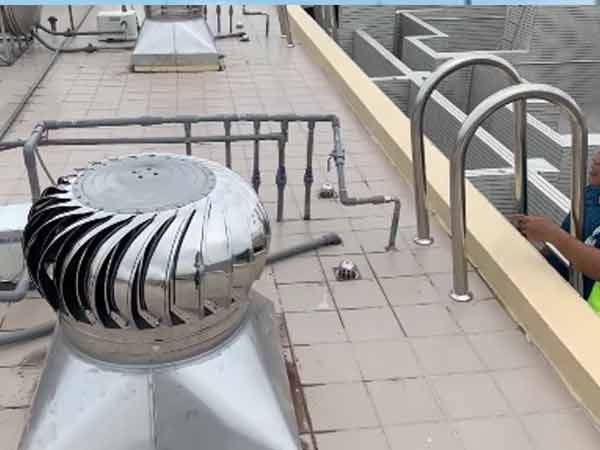
201SS Electric Natural Force Dual-function Ventilation Ball
Odour reflux and humidity are common causes
Odors from the common pipes in the community building often originate from more than one source: it could be that the top-floor exhaust vents are poorly designed, the negative pressure in the pipes is insufficient, or the pipes connecting between floors are not properly connected, causing gas to flow in the wrong direction. Alternatively, the forced ventilation systems installed by the residents of different floors may be interfering with each other. Excessive humidity is often caused by insufficient ventilation in the pipes, and the water vapor cannot be expelled. Since the causes are diverse, it is recommended that the main problem points be identified through on-site inspection before deciding on the improvement method; instead of assuming that installing one ventilation fan will solve all the problems of odors and humidity.
How does the exhaust system work between the common pipes?
The ventilation design between the common pipelines usually involves exhausting the air from the entire floor through the roof exhaust vents, creating a downward flow of air. If the roof exhaust vents become blocked, the airflow is insufficient, or the ventilation outlets on different floors are poorly designed, the airflow can become turbulent, and even in certain floors, there may be insufficient negative pressure or gas backflow.
Top floor openings, pipe diameters, supplementary ventilation, and floor pressure differences
When designing the improvement plan, the opening size of the top-floor exhaust vents, the actual diameter of the pipes, the conditions for supplementary ventilation at each floor’s air outlets, and any pressure differential issues that may exist between floors must all be taken into account. When conducting the actual inspection, Engineer Da Ben Ying Co. Ltd. will actually measure the pipe dimensions, the number of floors, and the condition of the existing ventilation equipment to serve as a basis for recommending the type of equipment and the number of units to be installed.
How to choose an electric/natural force model
Depending on the wind conditions at the site and the severity of the odor, you can choose to use a natural-force ventilation ball, an electric ventilation ball, or a dual-function model; see details below.Electric fan ballProduct page. If the odor problem is more serious, combined with the unstable natural wind conditions onsite, it is usually recommended to choose a model equipped with an electric mode for more stable exhaust air performance.
Four-way turning, extended tube seat and waterproof construction
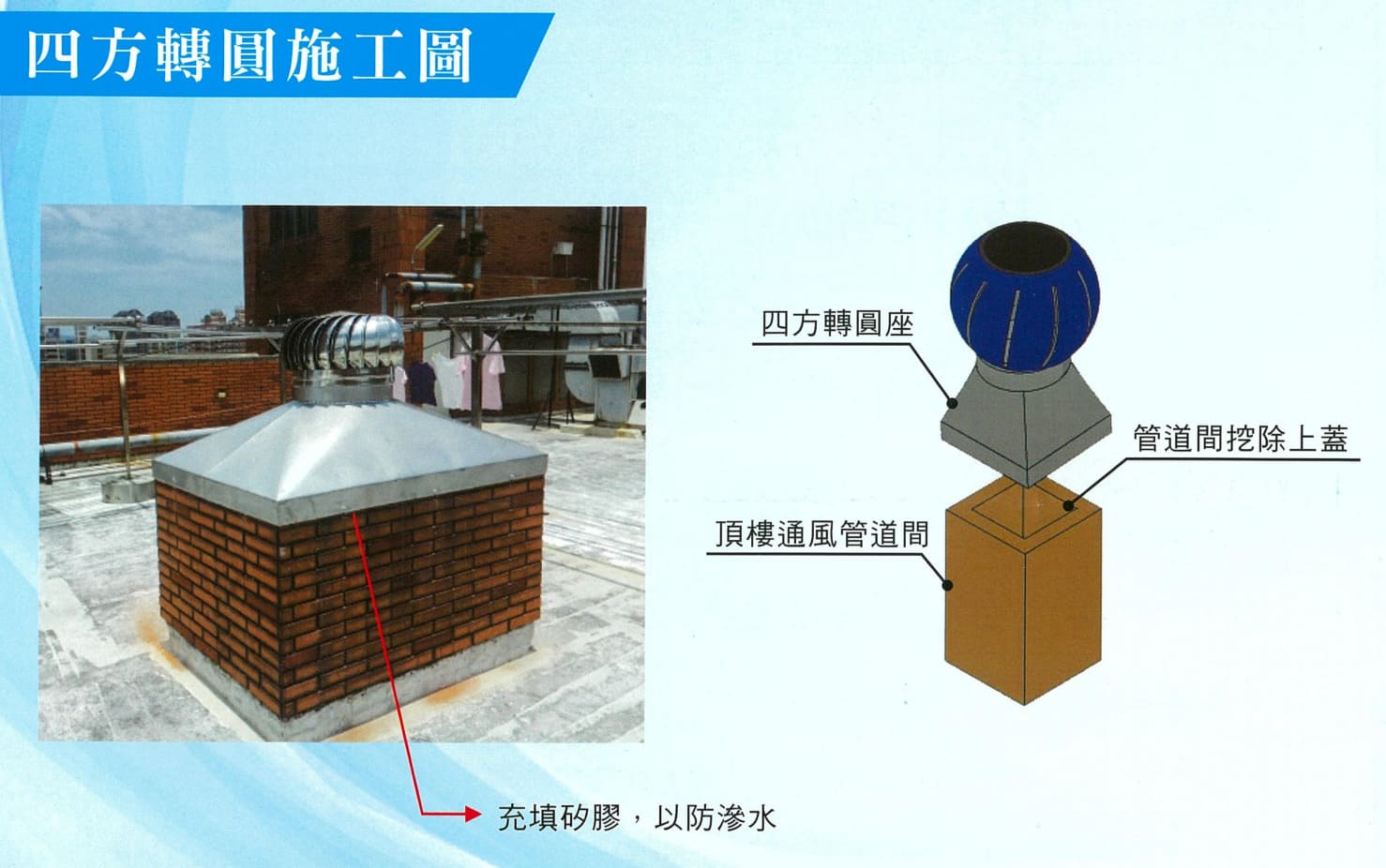
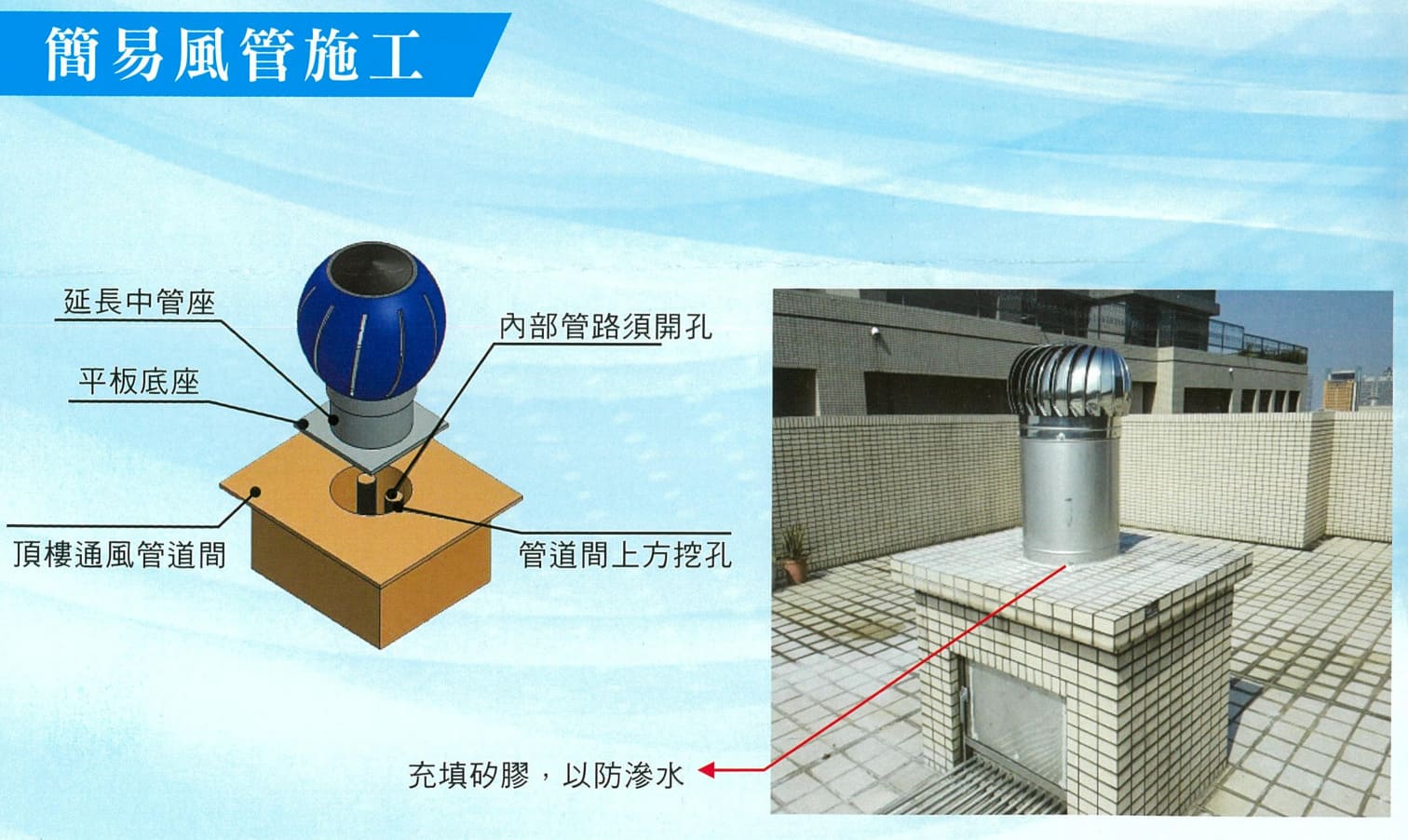
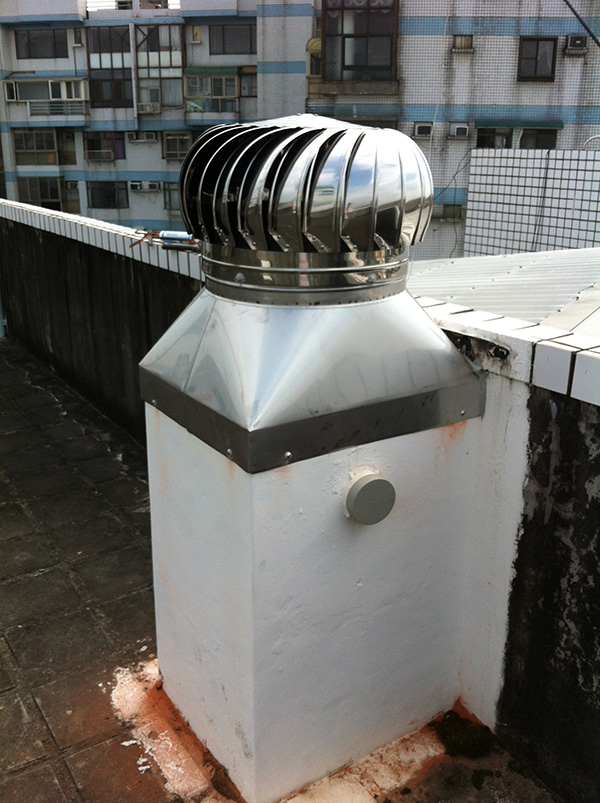
During actual construction, you may need to use adapter fittings such as a square to round connector to connect the existing pipe shape to the ventilation equipment interface. Depending on the pipe height, an extension tube should be installed. The quality of waterproofing at the roof hole and equipment fixing locations directly determines whether there will be any water leakage in the future. It is recommended to confirm the waterproof connection points with the team before construction and retain a complete construction record.
Community construction process and management coordination
The ventilation improvement project for the community building usually involves the approval of the board of directors, coordination with residents, and the construction schedule. Da Ben Ying Co. Ltd. suggests that before the official start of construction, the board of directors should be informed about the scope of work, the estimated duration, and the public areas that may be affected, and that precautions be announced in advance to minimize disruption to residents’ daily lives.
Case studies and on-site inspections arrangements
The actual improvement cases vary in terms of flow rate and resident feedback depending on the building structure and the problems involved; for detailed case studies, please refer to the following link.Ventilation engineering casePage.
Case Realities
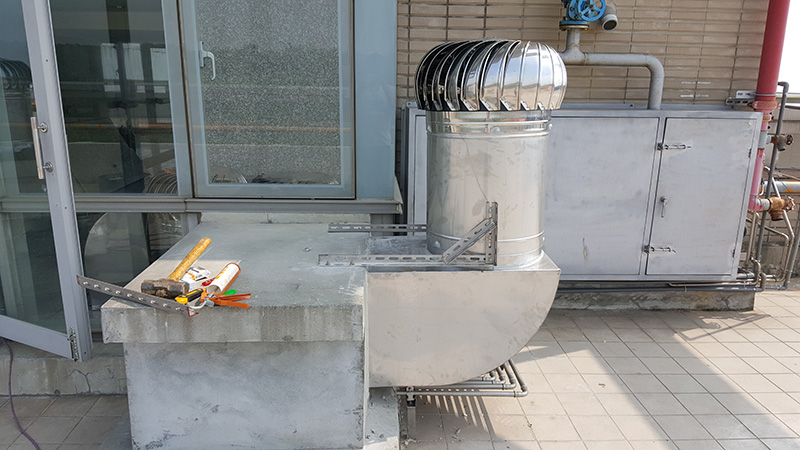
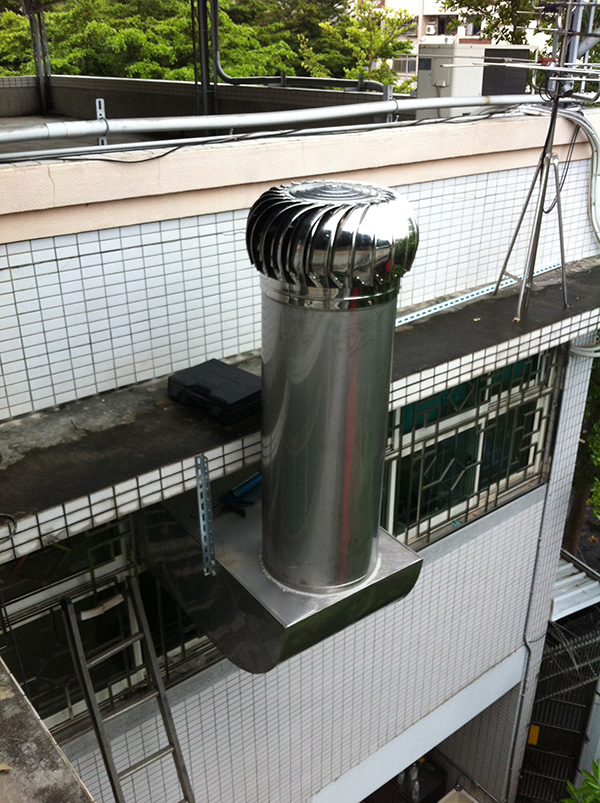
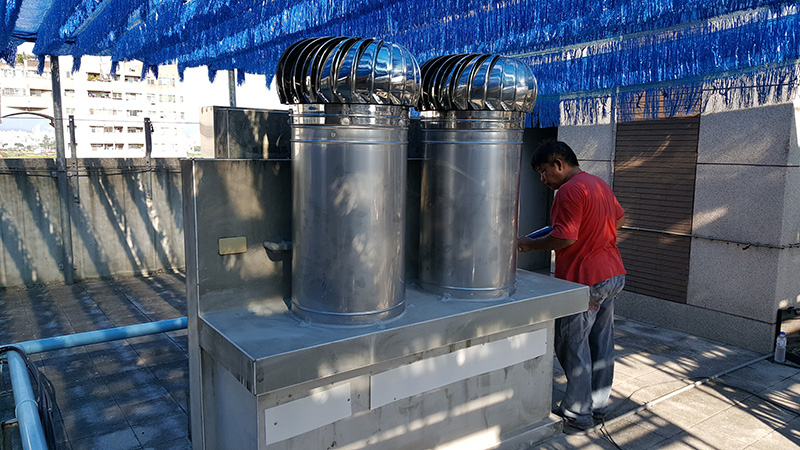
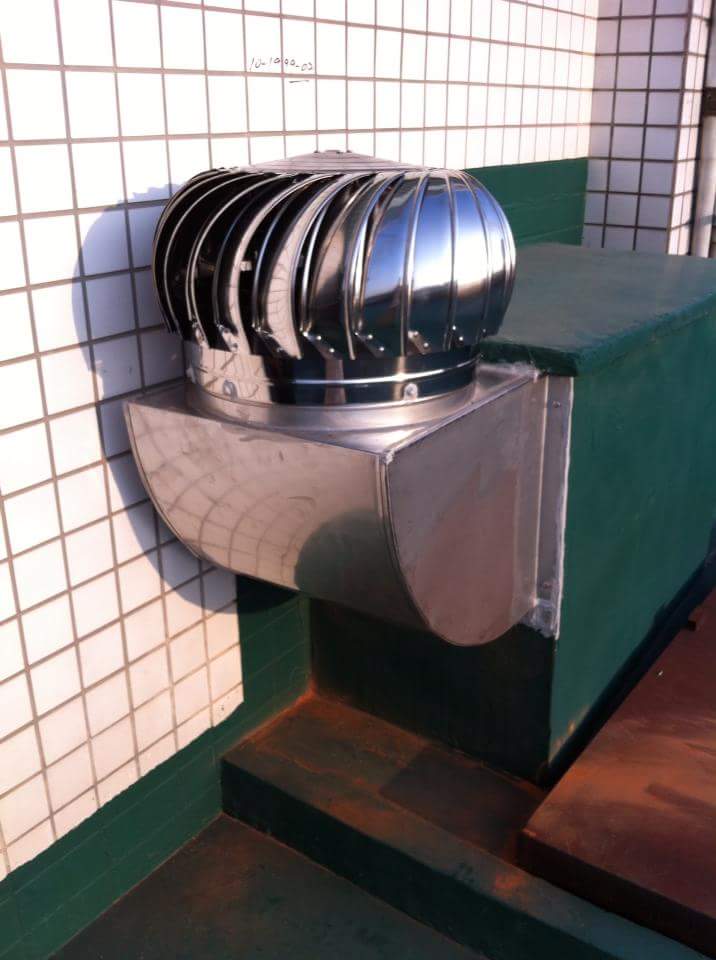
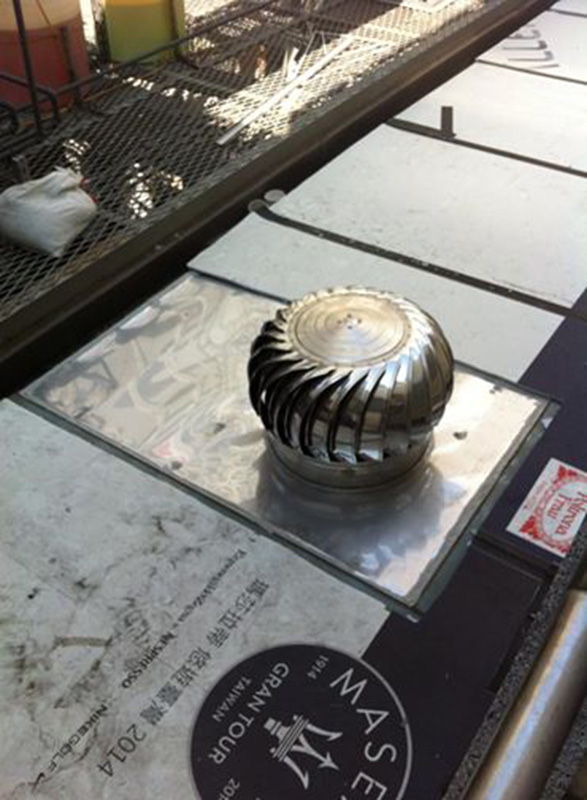
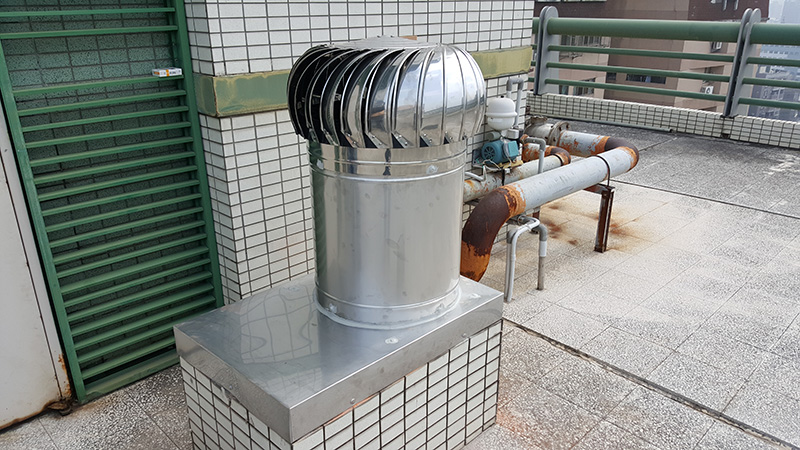
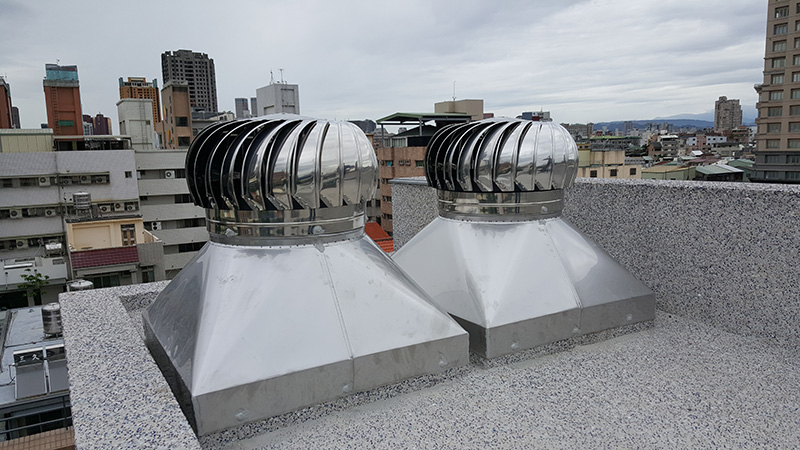
Comparison of the functions of exhaust systems between various types of pipes
| Section | Comparison items |
Electrodynamic Natural Force
|
Natural power
|
Solar wind turbine
|
Electric exhaust fan
|
No improvement in the pipes
|
|---|---|---|---|---|---|---|
| 1 | Features | It can quickly remove the damp and odorous smell. | When there is a slight breeze, the function is not good. | When it rains, the function is poor. | It can quickly remove the smell of moisture and odor | When there is a light breeze, the stale smell of the air will be drawn into the interior. |
| 2 | Eliminates moisture | It can quickly and thoroughly remove condensation droplets. | Elimination of moisture effect is limited, easy to form condensation droplets and easy to rust | Rainy days are not ideal, and condensation is easy to form. | It can quickly and thoroughly remove condensation droplets. | Limited amount of emitted moisture |
| 3 | Waterproofness Preventing bird nests |
The vortex is such that external drainage droplets cannot penetrate and cannot form a bird's nest. | Same here. | During strong winds and rain, there is a possibility of rainwater entering the nest, making it easy to build a bird's nest. | During strong winds and rain, there is a possibility of rainwater entering the nest, making it easy to build a bird's nest. | Strong winds make it easy for rainwater to overflow and build bird nests. |
| 4 | Power | 1/4 horsepower design, axial turbo consumes less power and produces no noise. | Without power, there is no function. | Motor current 1.6A, motor rotates directly, the wind fan has noise | The motor has a 1-2 horsepower design, consumes a lot of electricity, and cannot vent air without power. | Without power, there is no function. |
| 5 | Durability | The motor casing and bearings are made of stainless steel, which is not easily corroded and is not susceptible to damage from ammonia gas. | Easily corroded by pipeline ammonia, not transferable (already seen in very common large-scale buildings) | Easily susceptible to rust damage from pipeline ammonia | Easily susceptible to rust damage from pipeline ammonia | Durable for a long time, but susceptible to weather conditions; excessive leakage of odors can enter the interior of the room and the elevator shaft. |
| 6 | Noise | The coaxial design of the motor and the turbine does not generate noise. | It does not generate any noise phenomenon. | The motor-driven fan has a slight noise. | Larger horsepower, with noise phenomena; produces resonance noise | 無 |
| 7 | Low pressure Rainy day |
It is not affected by weather conditions, eliminating the flow of dampness and odors | When there is little wind and low pressure, the exhaust is limited and not good. | It is completely unable to remove ammonia gas; the pipes are prone to leaving a foul odor. | It is not affected by the weather, but there is a chance of rain. | Low pressure, rainy days, and indoor odors are stronger and harder to dissipate. |
Common Questions (FAQ)
Does the 201SS need to be plugged in to operate?
Not necessarily.201SS It has both natural and electric power functions. When wind conditions are favorable, it operates reliably with natural power; only when additional ventilation is needed, the electric mode is activated and the unit is powered on.
Air flow rate 2664 m³/h, can I achieve the same result in my site?
This is a specific test condition (such as 8 mph The reference value under wind speed will vary depending on the wind speed, installation method, and pipeline conditions. We recommend requesting a complete test report and having a technician assess the actual ventilation requirements on-site.
Is the 201SS suitable for installation on residential roofs?
The installation can be evaluated; the actual size, pipe diameter compatibility, and installation method are recommended to be confirmed by a technician upon inspection.
Will the electric mode be noisy?
The noise level varies depending on the operating mode and installation method. It is recommended to request noise data for reference during the quote process.
Real-world operation video demonstration
Movie 01
Movie 02
Film 03
Movie 04
Film 05
Film 06
Film 05
Film 05
Film 05
Next step: Overview of ventilation equipment | Electric fan ball | High-Solubility Oxygenated Water Machine with Water Tower | Ventilation engineering case |Application review committee requests on-site inspection LINE Question