
Building and factory ventilation equipment
Otemori’s ventilation equipment business began with the development and manufacture of natural ventilation products. Currently, it offers options such as natural force, electric force, and dual-function ventilation balls, tailored to applications such as inter-community building common pipelines, factory factory premises, and general roof ventilation.
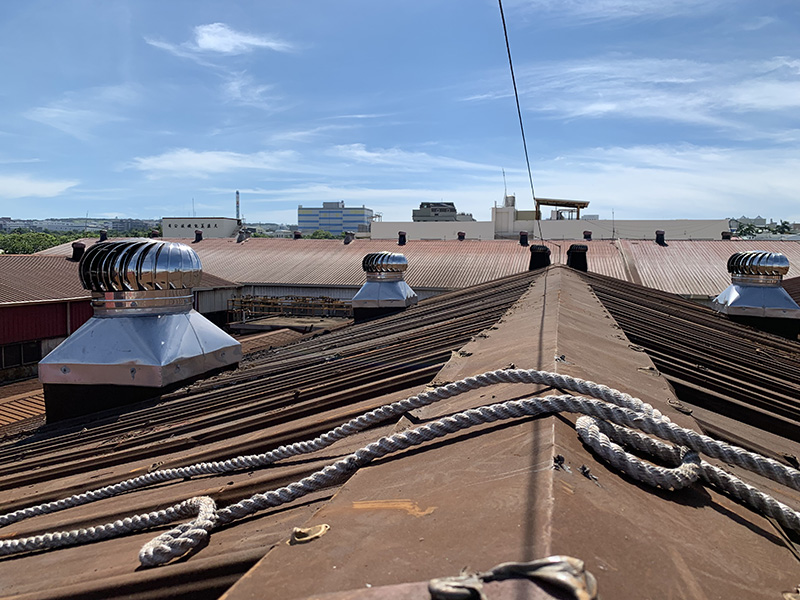
Regarding the ventilation issue, we need to first divide the scene into different areas.
Similarly, the cause and solution for "poor ventilation" are completely different in different environments. The ventilation problems in community buildings are mostly related to common duct negative pressure, top-floor exhaust outlets, and supplementary ventilation conditions in each floor; the ventilation needs in factory buildings often come from machine heat dissipation, roof-top heat accumulation, and work environment ventilation. Bigben will recommend clarifying the scene where the problem occurs and the root cause first, then decide the appropriate type of equipment and the number of units to install, rather than simply installing one unit and expecting all ventilation problems to be solved at once.
The air flow volume must be matched with ventilation and pipeline conditions.
To ensure effective ventilation, the ventilation and exhaust systems must be balanced properly. Installing only ventilation equipment without adequate exhaust routes often results in a significant reduction in the actual ventilation performance. Moreover, excessive negative pressure can lead to other problems (such as noise from doors and windows and airflow reversal). Therefore, when planning ventilation equipment, in addition to the ventilation equipment’s own airflow specifications, the ventilation routes, pipe sizes, and space volume of the installation site must also be considered.
Assessment of roof waterproofing, rain prevention, and wind resistance
Most ventilation fans are installed on the roof, and construction involves drilling holes and waterproofing. The quality of installation directly determines whether or not water will leak in the future. The equipment itself also needs to have certain rain and windproof design to prevent strong winds and heavy rain from affecting operation or causing damage. The actual waterproofing method and windproof rating should be confirmed clearly at the time of quotation with the sales department, and the construction record and warranty certificate should be kept.
On-site inspection, construction, and warranty
The causes of ventilation issues vary depending on the case. Dai Benying will recommend arranging a site inspection before providing a quote. After that, we will measure the pipe dimensions, roof structure, and space volume on-site, and then provide recommendations regarding the equipment model, configuration quantity, and construction method. The warranty terms are subject to the terms of the official warranty booklet.
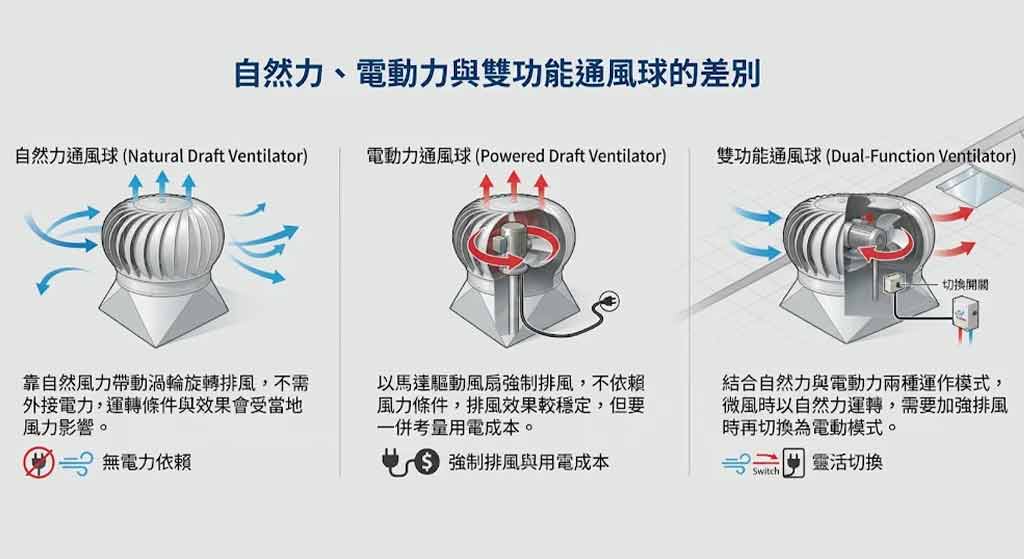
The difference between natural power, electric power, and dual-function power
Natural Force Ventilation Ball—The turbine rotates by natural wind power, requiring no external power; operating conditions and performance are affected by the local wind conditions.
Electric powered fan ball——Driven by motors to force the exhaust air out, it does not depend on wind conditions; the exhaust air performance is more stable, but the cost of electricity consumption must be taken into account simultaneously.
Dual-function ventilation ball—Combines two operating modes: natural power and electric power. When the wind is gentle, it operates using natural power; when additional exhaust ventilation is needed, it switches to electric power; see details.Electric fan ballPage.
The piping in the building and the factory have different design logics.
The key to ventilation in building pipes is to address the problems of backflow of odours and moisture caused by insufficient negative pressure in common pipes and poorly designed top-floor exhaust vents. For details, seeAirflow between building pipesPages. Factory ventilation focuses on overall heat source management, estimation of ventilation frequency, and ventilation configuration for large areas of space; see details.Factory ventilation equipmentPage.
Common problems
Can a single ventilation ball solve all ventilation problems?
Not necessarily. The ventilation effect depends on a comprehensive evaluation of the ventilation path, pipeline conditions, and the number of equipment configurations. It is recommended that the technician conduct an on-site inspection and then submit a complete configuration proposal, rather than installing only a single device.
How to choose a natural and electric powered ventilation ball?
Natural power is suitable for wind power sites where conditions are stable and do not want to increase electricity costs; electric power is suitable for sites where stable exhaust performance is required and wind conditions are unstable. The dual-function model can switch between the two modes depending on the situation, see details below.Electric fan ballPage.
Will installing a ventilation ball cause roof leaks?
Installation quality is crucial. It is recommended to verify the waterproofing techniques used by the construction team and retain complete construction records and warranty certificates to reduce the risk of future water leaks.
Are the ventilation systems in community buildings and factories the same?
The causes and configuration logic of the two are different, so it is recommended to refer to them separately.Airflow between building pipes與Factory ventilation equipmentThe page is assessed individually by the technician based on the conditions on site.